Open plan 2.0: collaboration by eavesdropping
 Wednesday, November 11th, 2026 9:30 am by
admin
 Print this page
Every so often somebody rediscovers that walls are the enemy of progress. On the web the walls were editors, and knocking them down was going to release the wisdom of the crowd. In the office the walls were drywall, and knocking them down was going to release collaboration. This blog spent a long time watching the first experiment. The second one deserves the same cautious look.
Its results are easy to check, because you can hear them. A sales call on speakerphone across the aisle. A colleague who drops by “for a quick one” and stays until you have lost the thread of whatever you were writing. That is less collaboration than eavesdropping, with everyone enrolled in everyone else’s calls whether they asked to be or not.
The fix that works is modest: a door. On an open floor that can mean one of the enclosed work pods Silentbox sets down in the middle of the room, a booth for one person with a desk, a chair, a light and a socket, where you can close the door and stay with a task until it is finished.
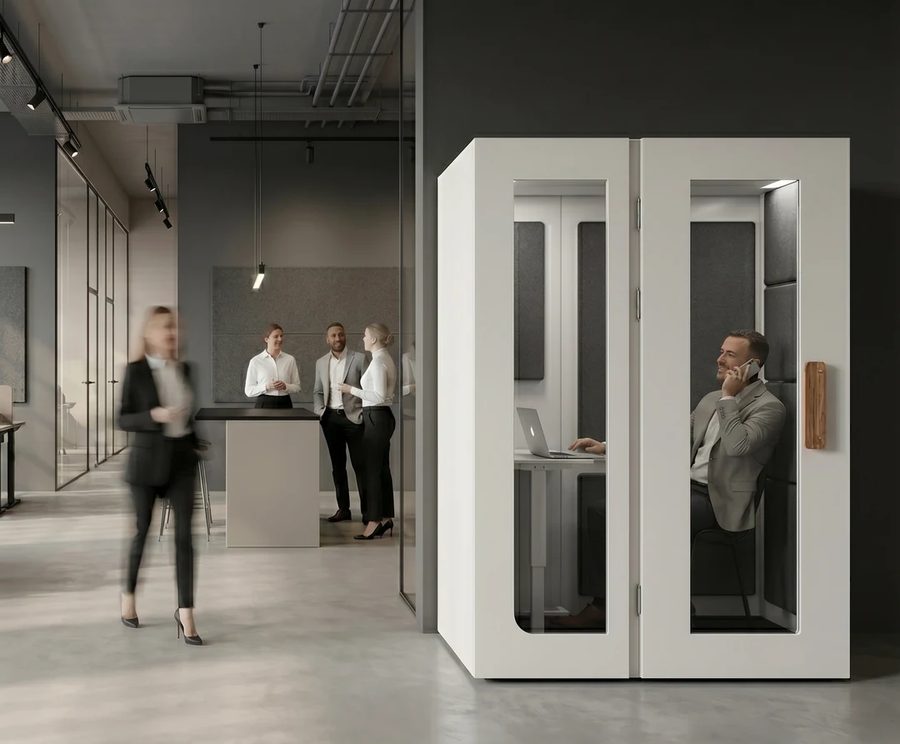 |
| A work pod on an open floor: the call happens at a desk behind a closed door, while colleagues talk by a standing table outside. |
The brochure and the floor
The pitch for the open plan was written in the same register as the pitch for Web 2.0. Information wants to flow, and the next big idea is waiting by the coffee machine. We have heard this before. The case for why Web 2.0 looked inevitable was made on this site with power laws and book sales; the case for the open office was made with floor plans and photographs of cheerful people at long white tables. Both brochures described what the new architecture made possible. Neither said much about what it made unavoidable.
What it made unavoidable was speech. Anyone who has worked by a window on a busy street knows the traffic fades after a while. A half-heard conversation never does, because some part of you keeps listening for your own name.
Thinking is still done alone
An earlier post here on the nature of collaboration made a point that has aged well: “the process of thinking, so far as we can tell, is a private one.” Groups can pool the results and argue over them. The thinking itself still happens in one head at a time.
An open floor treats that private process as a scheduling problem. Deep work is expected to happen between interruptions, in whatever gaps the room leaves open. Anyone who has tried to finish a difficult paragraph while the next desk negotiates a delivery date knows how narrow those gaps are. Headphones are the standard workaround, and a telling one: each wearer builds a small private office out of their own noise, and it still does nothing about the tap on the shoulder.
A room with a door
The work pod is an admission, which is what makes it interesting. It concedes that the open floor will not be fixed by etiquette, or by one more memo about taking calls elsewhere. Instead it puts a free-standing booth in the middle of the room, fitted out for sitting and working rather than standing and talking: a desk at working height, and quiet ventilation so the air does not go stale over a long session. The conversation at the next desk stays at the next desk. Nobody wanders through your line of sight.
There is a quieter advantage as well. The booth goes up without builders and comes apart again when the layout changes, so nobody has to declare the original floor plan a failure. In office politics that matters more than acoustics. Whoever championed the open floor gets to keep it, and the people who need to think get somewhere to go.
Wiki means quick
Wiki is Hawaiian for quick, and this blog took its name from the Hawaiian word for careful. The open plan was a quick idea, cheap to build and easy to photograph. None of this makes the crowd useless, at work or online. Connectivity pays off when the intent is clear, as another post here argued, and a team that knows what it is trying to do will find ways to talk. The trouble starts when sitting together is taken for working together.
So the next time a reorganization promises more collaboration, the careful response is to ask who will be doing the thinking, and where. If the answer is a long white table and a pile of headsets, ask for a door as well.